
The hardest thing to find in language learning is a patient French speaker at 7:15 on a Tuesday morning, when I happen to have twenty minutes and feel like talking about my weekend. Everything else I can get on demand. I can open a book or put on an audio lesson whenever I want, study vocabulary at six in the morning, and practice verb conjugations before bed. What I have never been able to do is summon an ordinary conversation, and that has always been the missing piece.
I have been interested in languages for most of my life, and not casually. Spanish and French are the two I have worked at hardest, but over the years I have dabbled in at least half a dozen others, and that is before you count my occasional fascination with constructed languages, or conlangs.1 I buy language courses and listen to the lessons in the car. I study grammar, read about how languages work, and try out different learning systems, and every so often I decide that this time I am going to become fluent. I enjoy all of it.
And yet, after all of that study, I have spent years running into the same wall, which is that I do not get enough chances to speak. That sounds almost embarrassingly obvious when I write it down, since nobody learns to have conversations without having them. For an adult learner who doesn't live somewhere the language surrounds them, though, it is a much bigger problem than it sounds.
I Have Learned a Lot of Language
The frustrating part is that I am not starting from zero. I know a fair amount of Spanish and a fair amount of French, and I have wandered into other languages often enough to recognize the patterns and the problems that keep coming back when you try to make a new language feel natural. Spanish and French are where it shows most, because I know enough of both to see how much I know and how much of it disappears the moment I have to use it with another person.
Depending on the subject, I can read things that would surprise someone who had only heard me struggle to speak. I understand the grammar, I recognize a large vocabulary, and I can usually understand far more than I can comfortably produce. Give me time to think about a sentence and I can work out what I want to say. Then someone talks to me, and all of that knowledge feels locked in a filing cabinet somewhere in the back of my brain. I know the word, and I know that I know the word, and I cannot find the word. Or I start a sentence confidently and realize halfway through that I have no idea how to finish it, or someone answers me in perfectly ordinary language at native speed and my brain catches three words out of eleven.
Then comes the awkward little moment. "Uh." "Comment dit-on." "¿Cómo se dice?" Then English, then frustration, and then the conversation stops being a conversation.
It has happened often enough that I now think knowing a language and being able to use one are two different skills, though they obviously overlap. I have spent years building knowledge, and what I lacked was time spent developing reflexes.
Traditional Language Learning Has Helped Me
I do not think the tools I used failed me. Pimsleur helped a lot, because audio courses made me retrieve the language instead of just recognizing it. They trained my ear and my pronunciation, and they drilled sentence patterns until I could produce a response without staring at a page. Books and grammar helped, and so did vocabulary study and reading. Experimenting with other languages helped as well, because every new language gives you another angle on how people build meaning, what languages share, and the strange ways they differ.
None of it solved the problem I had, though. Those were all parts of the puzzle, and I was still missing immersion. The romantic version of immersion is moving to Madrid for six months and drinking coffee in a neighborhood café every morning, and what I needed was much simpler than that. I needed to talk, a lot, and I needed hundreds of ordinary conversations. I needed to talk when I was tired and when I could not remember a word, to tell the same kinds of stories over and over until the language stopped feeling constructed, and to do it with someone who would let me stumble through a sentence without turning the moment into a grammar lesson.
Most of all, I needed it available often enough that speaking could become normal, and conversation was the one thing in all those years of study that I could not buy, download, or schedule.
The Awkward Part of Learning a Language
One thing language courses cannot fully simulate is how uncomfortable an actual conversation is. You feel much less intelligent in a language you are still learning, and that may be one of the hardest parts. In English, I can explain a complicated technical idea, argue about politics, tell a story, make a joke, or find exactly the word I want. Put me in a French or Spanish conversation and I am suddenly explaining that same thing with the linguistic sophistication of a six-year-old, even though the thought itself hasn't gotten any simpler.
That gap is frustrating. Sometimes I know exactly what I want to say and do not have the machinery to say it, and sometimes I have the machinery but cannot retrieve it fast enough. Other times I start talking and discover halfway through that I have built myself into a grammatical corner, so I back out and start over, or reach for the wrong word and talk my way around the thing I mean, and occasionally I give up and say it in English. That is not a failure of language learning. I increasingly think that is language learning. You have to spend time inside that uncomfortable space, and the hard part is finding enough chances to do it.
I Already Have Lessons
That frustration is what got me experimenting with conversational GPTs for language learning. My first instinct was the obvious one, which was to build an AI language tutor, but the more I thought about it, the less interested I was in a tutor. I already have lessons. I can ask ChatGPT to explain the subjunctive whenever I want, and it will turn out vocabulary lists, conjugation tables, and exercises for as long as I keep asking. What I wanted was someone to talk to.
That distinction shaped everything once I started writing the instructions for the GPTs. I did not want every mistake corrected or every exchange to end with a question, and I definitely did not want "Excellent! Great job! Now let's practice another sentence!" Nobody talks like that. I wanted a conversation, which means sometimes the AI asks a question and sometimes it just reacts. Sometimes it laughs or pushes back with an opinion of its own, and sometimes it stays with something interesting I said. I wanted to talk about software one day and my granddaughter the next, without the conversation lurching into a new subject because the lesson plan decided it was time to practice restaurant vocabulary.
Conversation is the product.
The learning is still in there, happening inside the conversation instead of constantly interrupting it, and that became one of the central ideas behind the prompts I eventually wrote.
Teach Me Without Constantly Teaching Me
I thought about this more than almost anything else while designing the prompts. I absolutely want the GPT to teach me. I just don't want it acting like a teacher every thirty seconds.
Suppose I say something wrong in Spanish. A traditional instructional exchange would stop me, explain the rule, and have me repeat the correct form. Sometimes that is exactly what I need, though not every time. In an ordinary conversation it is often more useful for the other person to answer me using the correct form, so I hear it and see how it fits while the conversation keeps moving. Maybe the same structure comes back five minutes later and I try it myself, and maybe I get it wrong again, or maybe this time I get it right.
That is the learning experience I have been trying to build, with the teaching woven into the conversation so naturally that I sometimes forget it is happening.
Let Most Mistakes Slide
I make a lot of mistakes when I speak another language, and if every mistake becomes an event, the conversation gets exhausting. Imagine talking in English with someone who interrupts you every twenty seconds with "wrong tense," "wrong preposition," or "you should have used a different article." It's technically useful and socially unbearable, and eventually you just stop talking.
So I wanted the GPTs to make a judgment call. Did the mistake change what I meant, or make me hard to understand? Do I keep making the same one? Would correcting it right now help? If so, maybe correct it, and otherwise keep talking. What I'm after is getting comfortable producing sentences at all, and the accuracy can improve inside that process.
Please Do Not Interview Me
Another thing I learned quickly is that AI loves questions. Tell a GPT to be conversational and you often get a rapid-fire string of them. What did you do today? What did you eat? Who did you go with? That is an interrogation with good manners.
Conversations between people breathe. Sometimes someone asks a question and sometimes they tell a story or say something funny, and sometimes they just react and leave enough silence for the other person to decide where things go next. Those sound like small design decisions, but they turned out to be what separates a language exercise from a conversation, so I wrote them straight into the prompts. Don't ask a question after every response, and don't keep changing topics. Stay with the interesting things, remember what I told you, and talk to me like someone who was listening.
Meet Me Where I Am Without Announcing It
I also didn't want a placement test. I have taken enough tests and I know roughly where my skills are, and the answer depends on what you are measuring anyway. My reading is well ahead of my speaking, and my vocabulary is well ahead of how fast I can pull words out of it. Following a carefully spoken recording is a different skill again from following someone talking naturally.
So I wanted the GPT to work it out as we go. Start talking and notice how I answer, simplify when I'm struggling, and stretch me a little when I'm comfortable. Don't announce, "Based on your responses, I estimate that you are B1." Just talk to me. A good human conversational partner does this almost without thinking, adjusting to the person across from them, and I wanted the AI to do the same.
Let Me Struggle a Little
This one is tricky. I don't want the AI to rescue me too quickly, because struggling to find the language is part of the exercise. I also don't want to spend two minutes stuck because I can't remember the word for "screwdriver," and sometimes I need help.
So one of the ideas built into these GPTs is a kind of graceful recovery. Try again in simpler Spanish or French, or give me an example, and when that clearly isn't working, use a little English and then go back. English is allowed here as a bridge. Rigid immersion can get absurd, because if I spend ninety seconds misunderstanding a sentence that six English words would clear up, we are not learning efficiently. Switching to English the instant I hesitate defeats the whole purpose, though, and the interesting part is finding the space between those two extremes.
Remember the Conversation
This may be one of the most underrated parts of immersion. Friendships have continuity. If I told you yesterday that my granddaughter was going to a trampoline park, you might ask later whether she had fun, and if I mentioned that I was preparing for a hard meeting at work, you might remember it the next time we talked. It matters even inside a single conversation, because nothing makes an AI feel more artificial than telling it something important and having it ask for the same thing ten minutes later.
So I wanted these conversational partners to pay attention, to remember the people I mention, the things I care about, and what we were talking about, and to bring those up naturally. Memory matters because conversation is what teaches the language, and conversations work better when each one picks up where the last one left off.
I Think AI Changes Something Here
I am careful about claiming AI has "solved" anything, and it has not solved language learning. You still have to learn vocabulary and wrestle with grammar, you still have to listen and read, and above all you have to speak. Something does feel different now, though. For the first time, I have a patient conversational partner available almost whenever I want one. I can speak French at six in the morning and practice Spanish while driving, and if I decide tomorrow to revive one of the half-dozen other languages I have dabbled in, I can do the same thing there.
I can stop and ask what something means. I can make the same mistake ten times without embarrassing myself, ask for more correction one day and less the next, and talk about subjects I care about instead of whatever happens to appear in Chapter 7. And I can do it every day. For someone who has spent years fascinated by languages and never able to find enough consistent immersion, that availability is new.
Talking with people is still better, and human conversation has things AI cannot replace. That was never my problem, though. My problem was that I did not have enough of those conversations, and what AI finally gives me is volume, hundreds of conversations and potentially thousands. That could mean enough repetition that retrieving a sentence stops feeling like solving a puzzle, and enough exposure that ordinary spoken French starts to sound ordinary. It could mean enough practice that Spanish starts to feel like something I can use, enough mistakes that making them stops being a big deal, and enough time in the language that I eventually stop translating everything in my head before I speak.
That possibility did something I didn't expect, which was to make me excited about language learning again. I find myself wanting to speak French and practice Spanish, and wanting to dust off the languages I have only dabbled in, maybe even try new ones, just to see what happens when conversation stops being the scarce resource.
So I Built María and Amélie
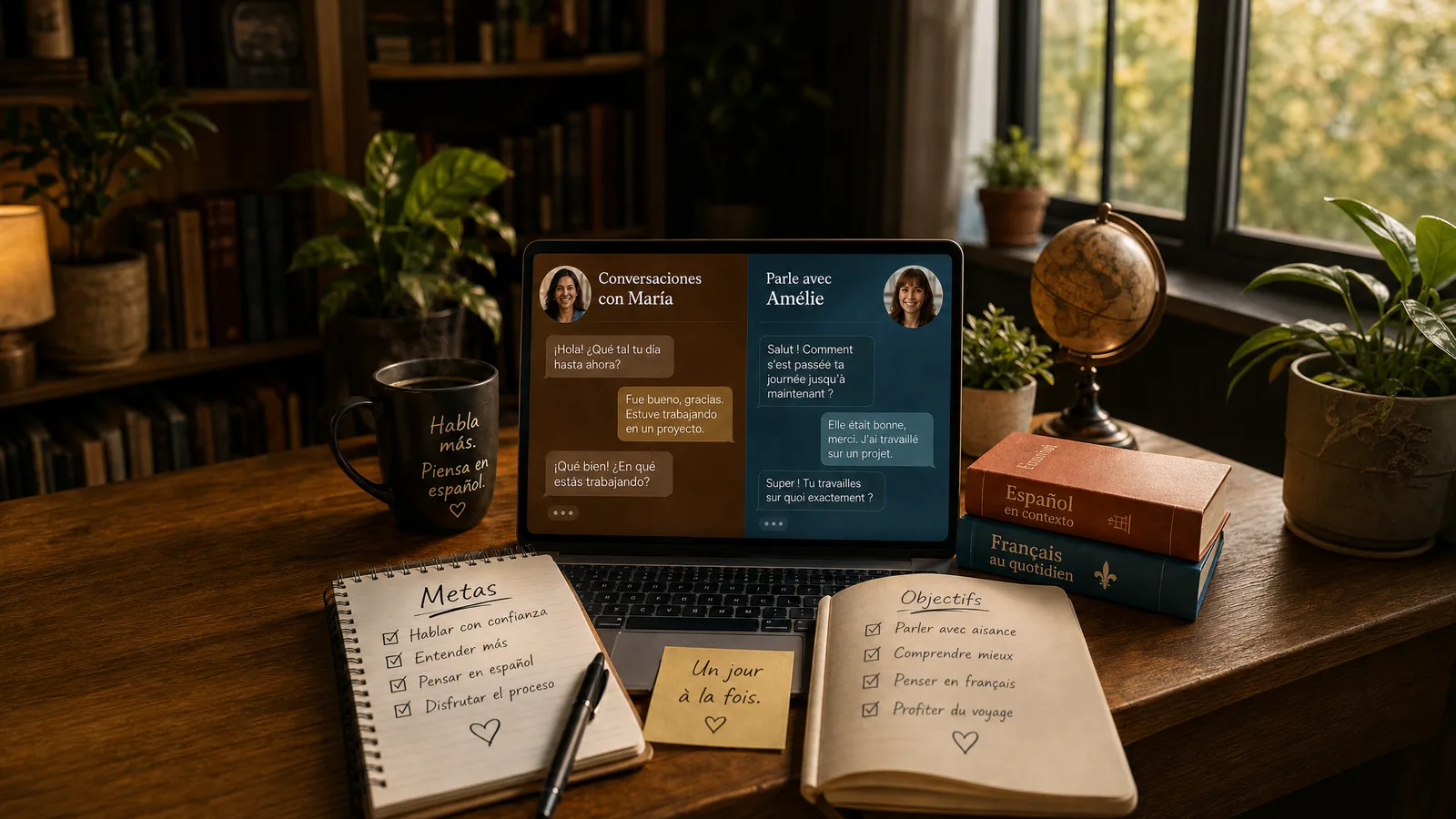
I have been experimenting with two GPTs built around these ideas. Conversaciones con María2 is my Spanish conversational partner, and Parle avec Amélie3 is the French one. I hesitate to call either a finished language-learning system. They are experiments, my attempt to take the little frustrations I have collected over years of study and turn them into a different kind of experience, one that feels less like an exercise and more like talking to someone.
Most of all, they are there when I want them. When it's early on a weekday and I have twenty minutes and something to say about my weekend, I finally have someone to say it to. That may sound minor, but after years of trying to learn languages without enough chances for immersion, it doesn't feel minor at all.
I expect the prompts to keep changing, and I know I haven't found the perfect one yet. What interests me is how much better this can get as I keep noticing what makes a conversation feel natural, what helps me learn without breaking the flow, and what gets in the way.
The prompts add up to a list of things that turned out to matter to me after years of trying, and I don't offer them as the correct way to learn a language. Mostly they ask for patience. Let me struggle but help me when I'm stuck, remember what I tell you, and keep giving me chances to speak until speaking becomes normal.
For years, immersion was the one part of language learning I could never manufacture for myself. Now I think maybe I can, and that makes me want to start all over again.
Frequently asked questions
Does AI replace traditional language learning?
- No. You still have to learn vocabulary, listen, read, and struggle with grammar, and courses like Pimsleur, books, and vocabulary study all help. AI fills a different gap: it gives an adult learner enough low-stakes conversation practice that speaking can finally become normal. It supplements the study; it does not replace it.
What is the difference between knowing a language and being able to use one?
- Knowing a language is recognition: understanding grammar, reading, and recognizing a large vocabulary. Using one conversationally is retrieval under time pressure, producing the right words fast enough to keep a real conversation moving. The two overlap but are not the same skill, and most classroom study builds knowledge far faster than it builds reflexes.
Why build a conversational partner instead of an AI tutor?
- Lessons are already easy to get: any capable model can explain the subjunctive, generate vocabulary lists, or produce exercises on demand. The scarce resource for an adult learner is conversation itself. A partner whose whole job is to talk with you, with teaching woven in rather than announced, targets the part that traditional tools cannot easily provide.
How should an AI conversation partner handle mistakes?
- Selectively, not constantly. Correct a mistake when it changes your meaning, makes you hard to understand, keeps recurring, or is useful to fix right now. Otherwise, model the correct form in the reply and keep the conversation moving. Interrupting every twenty seconds is technically useful and socially unbearable, and it eventually makes people stop talking.
Should the AI use English while practicing another language?
- English works best as a bridge, not a forbidden word or an automatic escape hatch. When you are stuck, the partner should first try simpler phrasing, another explanation, or an example, and only fall back to a little English when nothing else is working, then return to the target language. Rigid immersion wastes time; instant English defeats the purpose.
What does AI actually add to language learning?
- Volume. A patient conversational partner is available whenever you have twenty minutes, which means hundreds or potentially thousands of ordinary conversations. That is enough repetition and exposure that retrieving a sentence stops feeling like solving a puzzle, ordinary spoken French starts to sound ordinary, and making mistakes stops being a big deal.
Footnotes
- Constructed languages (conlangs) invented languages such as Esperanto, Klingon, or Tolkien's Elvish. ↩
- Conversaciones con María the Spanish conversational partner GPT. ↩
- Parle avec Amélie the French conversational partner GPT. ↩