
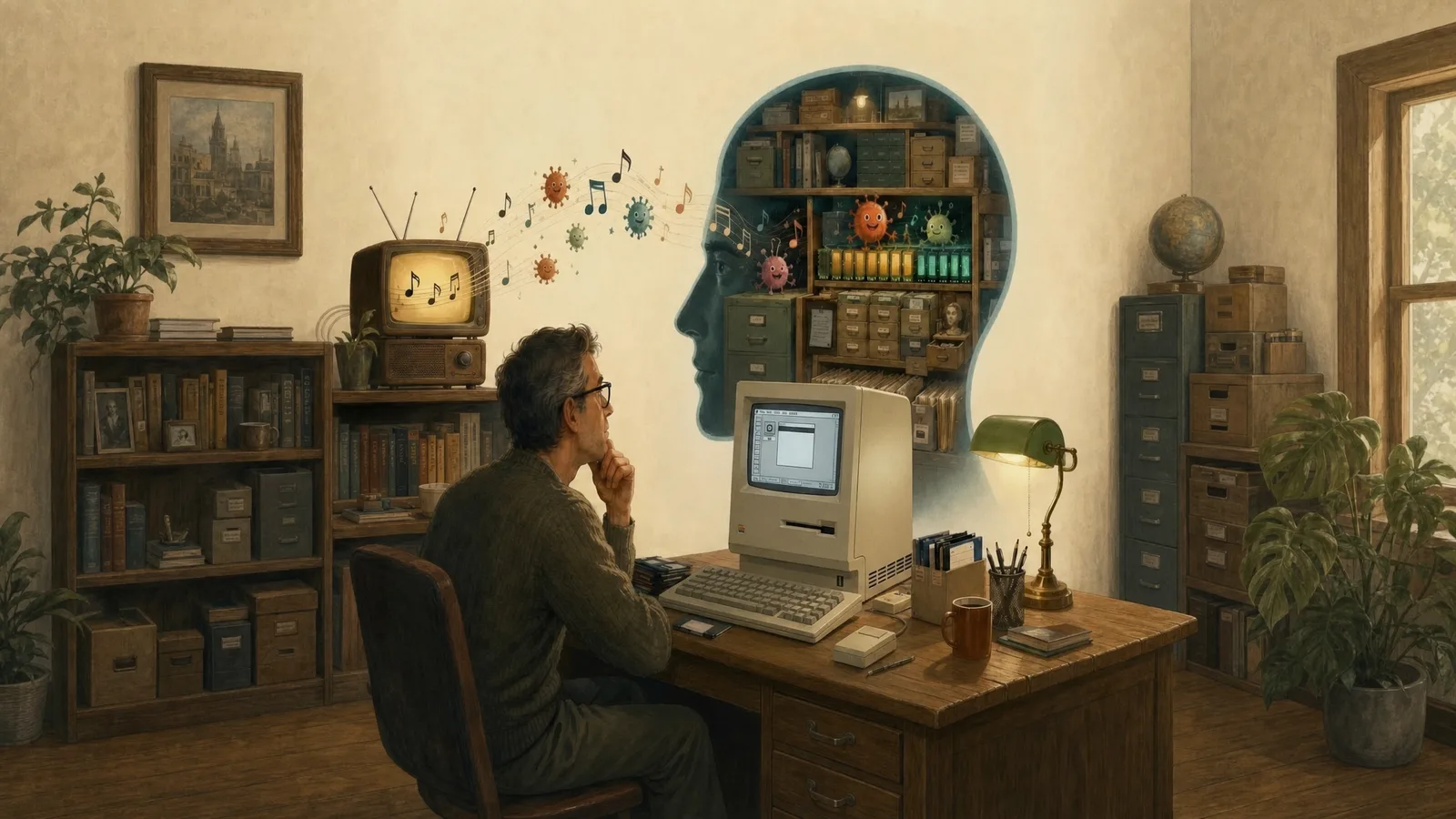
I have always thought of my brain as fixed storage.
That is probably not scientifically precise, and I am sure someone who studies memory for a living could tear the metaphor apart in ten minutes. I am fine with that. This is not a neuroscience paper. This is just how it has always felt to me.
Long-term memory feels like a hard drive. Short-term memory feels like RAM. You only get so much of both, and the short-term stuff is especially fragile. You load it up with whatever you are working on, and if something knocks you out of it, the whole thing starts to fall apart.
That is the part of context switching that feels under-explained.
It is not just that you stopped doing one thing and started doing another thing. It is that you had a whole working set loaded in your head. You had facts, constraints, half-formed ideas, assumptions, emotional state, next steps, and unresolved questions all sitting there together. They were not just facts. They were arranged into something useful.
Then someone walks in, or a meeting starts, or a phone rings, or life happens, and the whole thing gets flushed.
Later, when you try to go back, you cannot just resume. You have to rebuild the room. You have to put the facts back on the table. You have to remember why one thing mattered and another thing did not. You have to reconstruct the shape of the problem before you can start making progress again.
That is expensive.
This is one of the reasons deep work has always felt different to me than normal work. When I am really in something, I am using the whole context window. I am not casually thinking about the problem. I am filling the available space with it. I am holding the moving parts in my head at the same time so I can see how they relate to each other.
When I was younger, I did that more often. I could put on headphones, shut the world out, and go deep for hours. I still can, but I do not do it as often now. Life changes. Work changes. Responsibility changes. You spend less time as the person living inside one problem and more time as the person moving between problems, people, and decisions.
That changes how you manage context.
As an individual contributor, sometimes the job is to fill the whole window. You need the whole thing loaded because the work requires it. As a lead, a parent, a spouse, or just a person moving through adult life, the job is often different. You cannot hold everything. You have to choose what gets loaded, what gets stored, and what gets ignored.
I got good at ignoring things.
That sounds worse than I mean it, but it is true. I learned to decide what mattered enough to retain. If someone told me something and I did not believe it was relevant to what I was doing, what I needed soon, or what I could find later, I might not store it. Not because I was not listening. Not because I did not care. Because I was filtering.
That did not always work out well.
Other people do not always agree with your relevance filter. Someone may tell you something that feels very important to them, and you may decide it does not belong in your working set. Two minutes later they ask you about it, and now you look like you were not paying attention.
Maybe sometimes I was not. But sometimes I was doing something more selective than that.
I was trying not to pack my head full of things I did not need to carry. I was trying to remember how to find things instead of remembering the things themselves. That has always felt like a better strategy to me. I do not need every fact in my head. I need a good index. I need landmarks. I need to know where to go when the information becomes important.
That is where the hard drive metaphor comes back.
Long-term memory is not just storage. It has organization. Some people seem to have a clean memory palace. Some people have a junk drawer. Most of us probably have both, depending on the subject. The more you read, study, ask questions, and connect ideas, the better that palace gets organized. Learning is not just adding facts. It is building shelves. At least that is how it always felt to me.
But the funny thing is that not everything in long-term memory got there because you invited it in. Some things just infected me.
Years ago, when I used to talk about the brain as a fixed-size hard drive, my wife and I would joke about the Gilligan’s Island theme song. There are songs, commercial jingles, TV themes, and random bits of culture that got burned into our heads because we heard them too many times. They were not important. They were not useful. They did not make us wiser. They just got in. And once they were in, they became permanent residents.
I used to think of those things as viruses.
In one of my first jobs, we developed software for the first generation of Macintosh computers. My favorite was the SE/30. We were doing development, people were sharing disks...unsafe computing, Macs were everywhere, and eventually we got hit with nVIR. It was one of those early Macintosh viruses, and the thing I remember most is the feeling of it consuming space and being hard to clean up. As engineers and nerds, we spent a lot of time removing nVir but we also spent a lot of time understanding it. We disassembled it...the Motorola 68030 was an amazing chip at the time. We even had a disk labeled "petri disk". We thought that was very clever.
Today, that probably sounds quaint. The whole world was different then. Computers were smaller, storage was precious, networks were not what they are now, and a virus had a different kind of physicality to it. You could feel the machine getting eaten.
That became the metaphor for me.
The Gilligan’s Island theme song was the Gilligan’s Island virus. A commercial jingle was a little piece of mental malware. A pop song you did not even like could still wedge itself into your head and take up space forever.
You did not choose it. You did not need it. You could not uninstall it. That still feels true today.
We talk a lot now about AI context windows, and that language is useful, but it is not just an AI concept. People have context windows too. We have limited working space. We have long-term storage with strange indexing. We have carefully organized shelves and useless junk we cannot throw away. We have facts we intentionally keep, facts we intentionally ignore, and songs from childhood television shows that apparently have lifetime leases.
Maybe that is why context is such a strange thing.
It is not just what you know. It is what you can load. It is what you can find. It is what you accidentally carry. It is what you decided not to remember because, at the time, it did not seem worth the space.
And sometimes, years later, the thing still sitting there is not some important lesson or carefully studied idea.
Sometimes it is just the theme song from Gilligan’s Island, taking up a little corner of the palace, still playing.