
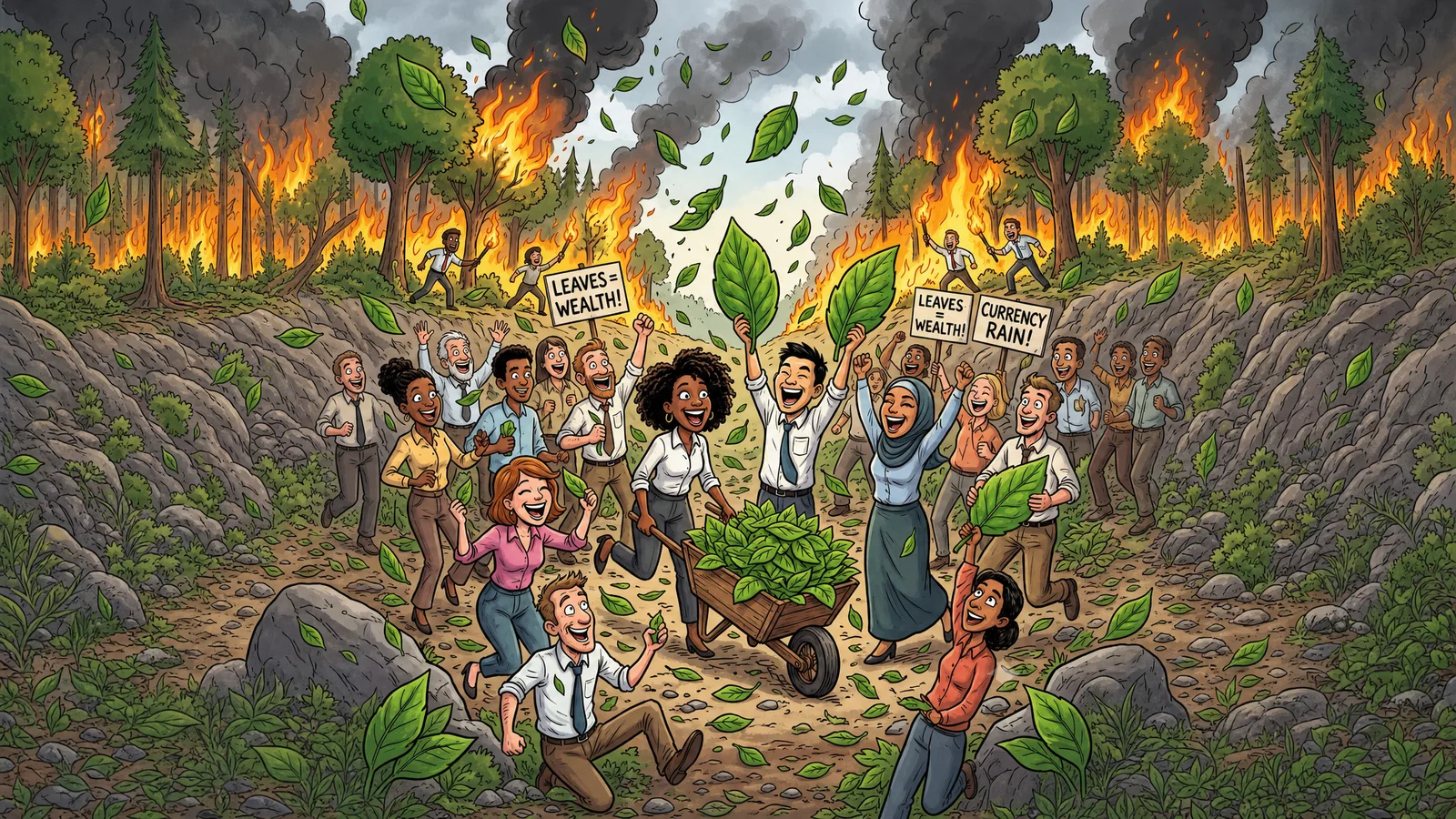
In Douglas Adams' The Restaurant at the End of the Universe, a ship full of the galaxy's most useless citizens, telephone sanitizers, account executives, and marketing consultants, crash-lands on prehistoric Earth. With nothing better to do, the Golgafrinchans declare leaves to be legal tender. Overnight, as Adams writes, they all become "immensely rich."
The trouble is that trees are everywhere. Leaves flood the economy, inflation runs wild, and before long a packet of peanuts costs three entire forests. Their fix is exactly as sensible as the currency they picked. They burn down all the forests, so that the leaves left over are scarce enough to be worth something again.
Adams plays monetary policy for farce, and the joke works because it is uncomfortably close to true. Money has value only because we all agree it does, and the scarcity behind that agreement can be created or destroyed almost at will.
The Same Joke, With Suits
Now look at our own planet. When the financial crisis hit in 2008, central banks responded by planting trees, flooding the system with money through quantitative easing. Then COVID arrived, and the U.S. alone pushed out roughly five trillion dollars in stimulus checks, enhanced unemployment, and business support. Suddenly everyone had more leaves.
What happened next would not have surprised anyone who had read the book. Inflation spiked, peaking around nine percent in 2022, the highest in forty years, and people felt it at the grocery store and the gas pump. To pull it back down, central banks hiked interest rates sharply, making borrowing expensive enough to burn some trees and drain the excess money back out of the economy.
The Part Adams Got Right
Douglas Adams saw the whole mechanism decades ago and wrapped it in a punchline. His target was never the Golgafrinchans or the central bankers so much as the comfortable belief that money is a solid thing, when it has always been an agreement we keep renegotiating. Whether the currency is leaves, dollars, or digital credits, the rule holds. Create a lot of money without creating any value to back it, and sooner or later you have to destroy some of that money so the rest is still worth holding. The scale is bigger now and the people doing it wear better suits, but the absurdity hasn't changed.
We are all still holding leaves.