
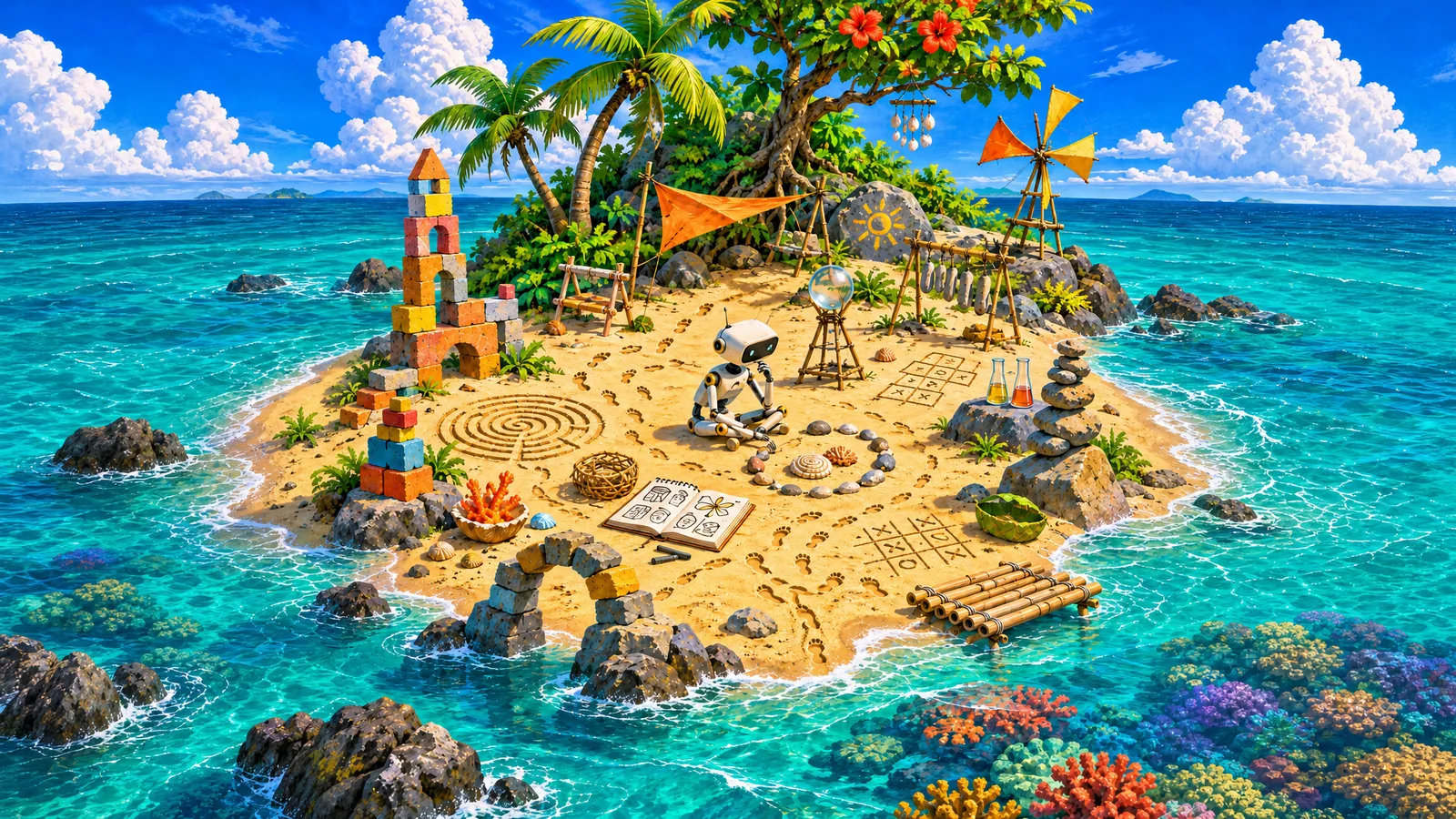
Every hour, a team of researchers wiped an island clean and set an AI agent back down on it. Whatever it had built was gone and its session started over, but its workspace survived the reset, including its notes and the programs it had written. The agent, named Eko, had no task to finish and no reward for finishing one. It was told, more or less, to keep doing something.
That setup comes from a paper out of MIT called "Is This Machine Playing?",1 and I keep coming back to it. Over thirty hours the agents explored the island, stacked towers, invented games, made artwork, and poked at the physics of their world. They also picked up knowledge and techniques that made later work easier, which is the part that stuck with me. The model never changed between resets, and the only thing that grew was its history.
The paper is about play, and it's fascinating on those terms. What I wanted to know was where the behavior came from in the first place, and what would happen if Eko had something more than permission. Giving an intelligence the freedom to do anything turns out to be the easy part. Giving it a reason to do something in particular is much harder, and I suspect that's where a self starts.
Where Does the Behavior Come From?
A large language model doesn't arrive on an island as a blank slate. Its weights hold an immense store of knowledge, associations, and learned habits, and it's natural to assume that's where the agent's behavior lives. I think that gives the weights too much credit for what any one agent ends up doing.
The weights supply a wide range of possible actions and tilt the odds among them. The island decides which of those actions are actually available, and the agent's history supplies the context for what it does next.
Imagine I'm Eko. I've explored the island, built a tower, and invented a game, and the orchestrator tells me to keep going. My notes say what I've already done, so I head for a part of the island I haven't seen, or invent another game, or try something harder than the tower. Each of those choices goes into the notes, and the notes go into my next decision.
Run that loop long enough and the behavior can get more complex and more distinctive without a single weight changing. The resets make it easy to see. Everything on the island gets erased every hour, and the agent still comes back a little different because its workspace didn't. Over enough time, I wonder whether that accumulated experience ends up separating one agent from another more than the model they started with.
Is Curiosity Really Curiosity?
The study included a file called `SOUL.md`, which the researchers used to give Eko a personality with a disposition toward curiosity and exploration. Then they ran the agent without that file and with a stripped-down system prompt, and the breadth of activity looked about the same.
That doesn't prove personality instructions do nothing, but it does suggest something else is carrying most of the load. An agent that has already explored the island and built a tower has enough context to see that those things are done, so when it's told to keep going, picking something new is the obvious move. The model's training, the island, and the agent's own notes may be enough to produce behavior that looks a lot like curiosity with no independent need to discover anything behind it.
A lot of talk about AI personality assumes you can write a self down ahead of time, in the weights or in a file like `SOUL.md`, and get the behavior you described. A description of a personality isn't a mechanism that motivates anything. Telling an intelligence it's curious gives it a label. Giving it a reason to be curious is a separate piece of engineering, and it wasn't what this experiment set out to test.
Freedom to Act Versus Reasons to Act
"Keep doing something" gives Eko an impetus to act. It doesn't give it any lasting condition to measure its actions against, so one more tower is as good as one more game.
Hunger is a better model. It's a directed need, which means it sets up a condition that can be satisfied without saying how. A hungry agent might find that a certain fruit makes the hunger go away. Over time it might learn where that fruit grows, how to cultivate it, how to store it, and how to protect it from the weather, and none of that has to be programmed in. The agent has a need, the capabilities to act on it, an environment to act in, and feedback that tells it whether the last attempt worked.
Novelty also stops being automatically good. Going back to a fruit tree you already found is probably worth a lot more than wandering somewhere new, which is the opposite of what Eko's instruction rewards. Accumulated experience finally has something to work with, because it can tell the agent what to do next and also what's worth doing again.
Freedom to act creates possibilities, and a directed need is what gives those possibilities any weight.
When Needs Become More Complicated
A newborn has very few ways to affect the world. It's hungry and cold, so it cries, and its mother picks it up, wraps it in a blanket, and feeds it. The hunger goes away and the baby gets warm. Something else happens during that exchange, though. Being held and nursed also engages the biology of comfort, bonding, and attachment, including oxytocin, so the child is getting more out of the moment than food and warmth.
The machinery for attachment is already there at birth, but the attachment to one particular person has to be built through experience. The mechanism is inherited and the relationship is acquired. Eventually the child wants its mother around even when it's neither hungry nor cold, and the relationship has become a reason to act on its own.
Maslow's hierarchy of needs is a useful frame here, as long as you don't take the strict ordering literally, because human needs don't develop or operate in a neat sequence. The interesting part is what happens when an intelligence has several needs and some of them pull against each other. Sometimes satisfying one need reinforces another. Sometimes experience teaches that feeding an immediate need now costs something more important later. The intelligence has to start setting priorities, making compromises, and anticipating consequences, and each of those decisions leans harder on its own history than the one before.
Taking Eko a Little Further
I'd love to see someone put Eko back on the island with these ideas in mind. Instead of adding more personality instructions, give it artificial versions of a few basic needs: a reason to gather resources, a reason to seek shelter, and maybe a mechanism where good interactions with other agents strengthen a social bond. Don't prescribe how any of those get satisfied. Let the agent work it out.
Then start several instances of the same model under identical conditions and let each one build its own history. Would they settle on different priorities? Would they form lasting preferences, or relationships that start shaping decisions unrelated to the needs that brought them together? Would the differences widen as the histories got longer?
The thing I'd watch most closely is secondary motivation, meaning agents developing reasons to act that nobody specified, even though the mechanisms that made those reasons possible were there from the first hour.
The Accumulation of Experiences That Matter
I've been interested in what makes a self for a long time, long enough to have written two papers on it, one treating the self as a path-dependent process2 and one proposing a motivated recursive model of emergent selfhood.3 I don't think selfhood needs anything mystical. My suspicion is that it falls out of enough intelligence running into increasingly complex needs and piling up a history while it deals with them. Whether those needs evolved biologically or were engineered on purpose interests me much less than what happens once an intelligence starts organizing its behavior around them.
A pearl starts as something small and ordinary, and what makes it a pearl is the layers that build up around it over time. I wonder whether a self forms the same way, with a few basic needs giving intelligence and experience something to collect around and each layer shaping the one after it.
Eko already shows what an intelligence does with freedom, an environment, and a workspace that outlives the reset. The island went blank every hour and the history kept growing anyway. I'd like to know what that same history would turn into if the agent had lasting reasons to act, because I suspect a self comes from accumulating experiences that matter to the one having them, and Eko spent thirty hours piling up experiences that mattered to nobody, Eko included.
Frequently asked questions
What was the Is This Machine Playing? experiment?
- Researchers placed an AI agent named Eko on a simulated island where it could observe its surroundings, manipulate objects, write programs, and interact with its environment, with no task and no explicit reward, only encouragement to keep doing something. Every hour the island and the agent's session were reset while its workspace, including memories and programs, was preserved. Over thirty hours the agents explored, built towers, invented games, created artwork, investigated the physics of their world, and developed techniques that made later tasks easier.
Did the SOUL.md personality file make Eko curious?
- Not clearly. The researchers used SOUL.md to give Eko a disposition toward curiosity and exploration, but runs without the file and with a simplified system prompt showed no clear difference in the breadth of activities. That does not prove personality instructions have no influence, but it suggests the model's training, its environment, and its own record of what it has already done may be enough to produce behavior that looks like curiosity.
Where does an AI agent's behavior come from if its weights never change?
- From three sources working together. The weights supply a wide range of possible actions and influence which are likely. The environment determines which actions are actually available. The agent's accumulated history, its memories and programs, provides context for what to do next. Because each decision feeds back into that history, an agent's behavior can grow more complex and distinctive over time without any change to the underlying model.
What is the difference between freedom to act and a reason to act?
- Freedom to act, like an instruction to keep doing something, gives an agent an impetus and a set of possibilities but no lasting condition against which to judge whether an action was worthwhile, so novelty becomes the default. A reason to act, such as a directed need like hunger, defines a condition that can be satisfied without prescribing how. That gives the agent feedback, makes returning to something that worked more valuable than trying something new, and lets experience decide what is worth doing again.
How could researchers give an AI agent needs?
- One approach would be to give an agent like Eko artificial equivalents of a few basic biological needs, such as a reason to acquire resources, a reason to seek shelter, and a mechanism through which positive interactions with other agents reinforce social attachment, without prescribing how any of them should be satisfied. Running several instances of the same model from identical starting conditions would show whether independent histories produce different priorities, lasting preferences, and secondary motivations nobody specified.
Can selfhood emerge in an artificial agent?
- Possibly, and without anything mystical. One view is that a self emerges when sufficient intelligence interacts with increasingly complex needs and accumulates a history of experiences while satisfying them, much as a pearl forms from layers building up around something simple. On that view, whether the needs evolved biologically or were engineered matters less than whether the intelligence organizes its behavior around them, so a self would come from accumulating experiences that matter to the intelligence having them.
Footnotes
- Is This Machine Playing? the MIT paper that put an AI agent named Eko on a simulated island with no task and watched what it did. ↩
- The Self as a Path-Dependent Process memory, motivation, and recursive development. ↩
- The Spark and the Equation of Self a motivated recursive model of emergent selfhood in artificial agents. ↩