
Picture a small railway station somewhere along a badly managed rail line. The stationmaster opens the building every morning and checks the platform. The signals work, the platform is clear, and he knows exactly what to do when a train arrives. Then he waits. The train is supposed to arrive at nine, but nine comes and goes, and it might show up at eleven, or late in the afternoon, or not at all.
Nothing is wrong with his station. Several stops back, freight is still being loaded, another train is sitting on a section of track, and a switching problem has backed things up farther down the line. Nobody has a reliable view of the whole railway, and every station manages its own small piece as though the rest of the line were someone else's concern. So the stationmaster sits in his booth with nothing to do, and from a distance he looks lazy. You could automate his paperwork, reorganize his desk, and hand him better tools, and the trains would run just as late as they did yesterday, because the thing holding them up is somewhere else on the line.
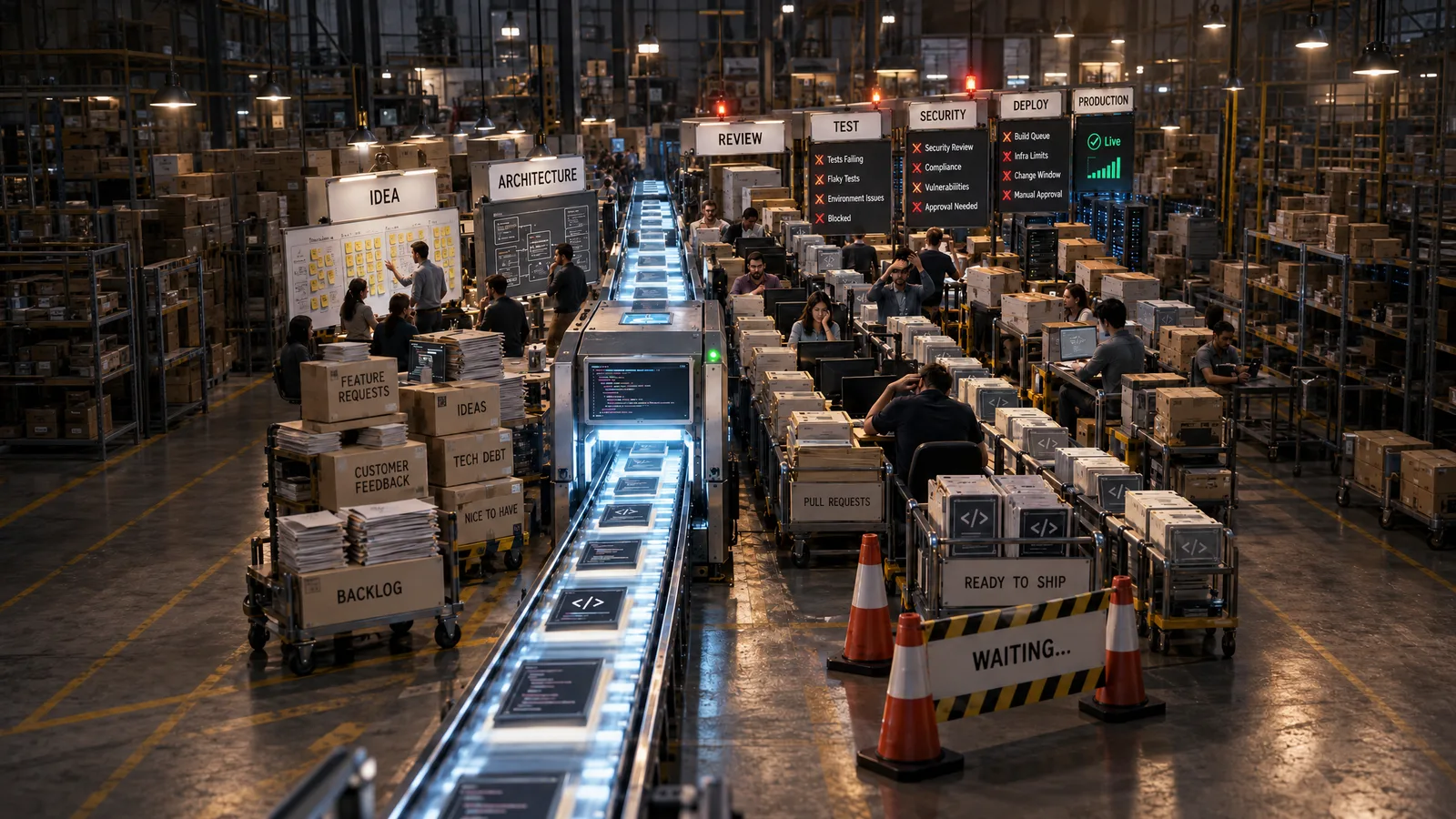
For most of the history of software development, coding was the train that rarely arrived on time. AI didn't make systems thinking important. It removed the bottleneck that had been hiding the system.
The Factory Was Mostly Coding
When I began my career, software development was largely synonymous with writing code. There were requirements, conversations, and decisions, but they took up a small part of the process, and most of the time went to implementation.
A request came in, someone decided what needed to be built, and the work was handed to a developer, where it disappeared into the coding station for weeks or months. That station took up most of the factory. Developers worked on their own machines or on shared development servers, where they wrote the application, tested it by hand, and rewrote whatever didn't fit. Nobody else waited around, because there was no reason to.
Eventually the software emerged, and then the organization had to figure out how to get it into production. In the earliest versions of this process, that barely resembled what we call deployment today. Software was copied onto media, physically carried to another machine, and installed by hand.
If you had drawn the floor plan, it would have shown a small intake desk by the door, a small delivery desk at the far end, and a coding floor filling everything in between.
We Built the Other Stations
Over time we built up the rest of the floor. Product management matured, architecture became a recognized job instead of something that happened inside one developer's head, and testing, release management, and production support turned into teams of their own. Then came a long run of movements, from extreme programming and Agile through continuous integration, DevOps, infrastructure as code, and continuous delivery.
Each of them improved part of the factory. Feedback loops got shorter, batches got smaller, and deployments became something you could repeat. By the time cloud platforms arrived, the supporting stations were sophisticated.
Implementation still took the lion's share of the work, though. A product manager could clarify a requirement in an afternoon, an architect could sketch a solution in a few hours, and a team could plan a sprint in a single meeting, and then the implementation took three weeks.
That imbalance shaped how we organized software development, from staffing models and job titles down to budgets and what we meant by productivity. We built whole organizations around the assumption that implementation was the scarce resource.
Systems thinking mattered through all of this, but its impact was hard to see. When one station consumes 90 percent of the total cycle time, tuning the others barely registers. A better intake process does little for throughput if the work still spends months in implementation, and a faster release checklist doesn't help when nothing is ready to release. Our stationmaster could run the tidiest platform on the line, and it wouldn't matter while the train was still stuck fifty miles away.
AI Changed the Shape of the Factory
AI is compressing the implementation station. It writes scaffolding, routine code, and tests, it explains unfamiliar components, and it helps engineers work in languages and repositories they've never touched. Software engineering is still hard, but a big share of the translation work is getting faster. For decades engineers spent much of their time taking business requirements, design constraints, and operational expectations and expressing them by hand in a language a computer could execute, and that translation is what AI speeds up.
When the largest station in the factory speeds up, everything around it comes into view. Requirements that were merely vague become active constraints. Weak architecture turns into a bottleneck, and so does slow code review, and so does waiting on a test environment or a security approval.
The bottleneck didn't go away. It moved.
Systems Thinking Was Always Important
Systems thinking looks like the new essential skill for AI-enabled software development, but operations research, industrial engineering, and software architecture have been working from the same principles for decades. What has changed is that we can no longer afford to treat them as secondary.
When implementation was slow, it absorbed organizational dysfunction. A developer could spend a month building a feature while the unclear requirements, the decisions nobody had made, and the missing test environment stayed out of sight. The delay gave the organization room to compensate, and AI takes a lot of that room away.
Making one station faster does not make the system faster, and AI development is running straight into that.1 A team can now produce code faster than anyone can review it, ship features faster than product leaders can validate them, and generate changes faster than the tests and the deployment pipeline can safely absorb them. Local productivity goes up while system throughput stays flat or gets worse, because work in progress piles up, the review queue gets longer, and the team arrives at the wrong thing sooner.
Stop Optimizing the Station
Traditional productivity thinking focuses on individual stations. How quickly can the developer write the code, how many tickets did the team close, and how many lines did the AI assistant generate?2 Those numbers are easy to collect, and they say almost nothing about whether value is moving through the system.
A highly productive coding station can bury every station downstream. A team generates twenty pull requests for reviewers who have capacity for five. Developers finish features that can't be deployed because the environment isn't ready, and AI agents close dozens of tickets that were poorly defined in the first place. On the dashboard the coding station looks great, while the work sits in queues.
It's tempting to blame the developers, the reviewers, or the tools. The trouble is station thinking itself, the habit of tuning each station as though the rest of the factory will take care of itself.
Systems thinking asks different questions. Where does work wait, and where does information get lost? Which decisions keep blocking progress? How quickly does the system notice that it's wrong, and how expensive is it to recover? What, specifically, slows an idea down on its way to a customer?
The Work Before Coding Becomes More Valuable
As implementation gets faster, the quality of the work going into it matters more. A vague idea handed to a slow development process produces a vague result slowly. Handed to a fast AI-enabled process, the same idea produces the same vague result much sooner, which only looks like progress.
Planning, architecture, and solution design get treated as bureaucratic obstacles to execution, and they are what make fast execution worth having. Clear boundaries make the work easier to split up, and strong architecture makes it safer to move quickly. Explicit acceptance criteria matter most, because they are how a person or an agent can tell whether the work is done.
This kind of planning does not require massive specification documents or a return to waterfall, as long as you are deliberate about intent, constraints, and feedback before the work reaches a station that can now turn it into code in an afternoon.
Execution Gets Easier, Judgment Gets Scarcer
AI will also change how engineering teams distribute work. Some tasks that once needed a highly experienced engineer can be done by a more junior engineer with good tools, reliable tests, and a mature delivery system behind them. That is valuable, and it changes where senior experience counts most.
Judgment is what gets scarce. Senior engineers will spend more of their time shaping problems, choosing boundaries, and weighing tradeoffs. They will build the environments where other people and AI systems can execute safely, and they will decide what gets automated, what needs a human reviewer, and where the system has to fail safely. Writing the hardest code becomes a smaller part of the job than designing the factory that code moves through.
That will eventually change organizational structures, career paths, and staffing ratios. The first change comes before any of that, though, and it is to stop treating planning, execution, and operations as separate activities that can be optimized independently, since each one feeds the next.
The Factory Is Finally Visible
For a long time, software organizations got by without seeing the whole factory. Implementation was so large that almost any delay could be blamed on coding. If delivery took six months, it was easy to assume the developers needed more time, more people, or better tools. AI is taking that excuse away. When implementation gets dramatically faster and delivery doesn't, the organization has to look at everything else that is slow, starting with the priorities nobody settled, the approvals sitting in someone's inbox, and a release process designed for a slower era.
The advantage goes to the organization that can move an idea through planning, implementation, and delivery as one flow, and to the teams that keep work in progress low, shorten their feedback loops, and make failure cheap.
The factory was always there, and a lot of software organizations are only now looking past the giant coding machine in the middle of the room to see it. The engineers worth listening to will be the ones who find a stationmaster with his feet up and ask where the train is, before anyone offers to reorganize his desk.
Frequently asked questions
Did AI make systems thinking important for software development?
- No. The principles have been part of operations research, industrial engineering, and software architecture for decades. What AI did is remove the implementation bottleneck that had been hiding the rest of the system, so weaknesses in requirements, review, testing, deployment, and decision-making are now impossible to ignore.
Where does the bottleneck move when AI speeds up coding?
- To the stations around implementation: vague requirements, weak architecture, slow code review, environment provisioning, security approval, testing strategy, deployment pipelines, product acceptance, and organizational decision-making. When one station gets faster, the constraint relocates to whichever station is now the slowest.
Why did systems thinking seem less important before AI?
- Because implementation consumed so much of the total cycle time that optimizing anything else produced limited results. When one station takes 90 percent of the cycle, a better intake process or release checklist barely moves throughput, and slow implementation also absorbed organizational dysfunction that would otherwise have been visible.
Does faster AI code generation increase delivery throughput?
- Not by itself. A team can now produce code faster than the organization can review, validate, test, and deploy it. Local productivity rises while system throughput stays flat or gets worse: more work in progress, larger review queues, more integration conflicts, and more opportunities to build the wrong thing faster.
What happens to planning and architecture as implementation gets faster?
- They become more valuable. A vague idea handed to a fast AI-enabled process produces a vague result much faster. Clear intent, strong boundaries, explicit acceptance criteria, and sound architecture are what make accelerated execution useful, for humans and AI systems alike.
How does AI change the role of senior engineers?
- Execution gets easier and judgment gets scarcer. Senior engineers shift from writing the hardest code to shaping problems, selecting boundaries, evaluating tradeoffs, designing feedback loops, and deciding what to automate, what needs human review, and where the system must fail safely. They design the factory.
Footnotes
- AI Speeds Up Execution, Not the System Around It on why accelerating the middle of delivery backs work up at planning and validation. ↩
- 10x Is the New 1x on why raw output metrics mislead once AI raises the baseline. ↩