Ctrl+Z may be the most trusted keystroke in software, but real systems are not text editors. Every serious conversation about AI agents is really a conversation about trust, and trust is not believing the agent will get it right. It is knowing what happens when it gets something wrong. Undo is not a button, it is an operational discipline: design, validation, controlled execution, reversal, compensation, and learning. The more we let agents act instead of advise, the more that discipline has to exist before we hand them the keys.
Operations7 articles
Talk to Dave. Only Sarah knows that pipeline. Use Jenkins, but not that Jenkins. Never on Fridays. Those are all answers to one of the fastest diagnostics in software: can I deploy your code, right now, safely, using the process the team claims to trust? A clean answer means deployment is a repeatable, disciplined process. The Dave answer means you have found a fragile system protected by institutional knowledge instead of engineering discipline. Every time a deployment requires a specific human instead of a repeatable process, you have found technical debt disguised as expertise.
A developer leaves standup with a ticket and comes back the same day with an implementation, a migration plan, and three pull requests; a year ago that was a week of work. AI made execution dramatically faster, but most teams are not bottlenecked on execution. They are bottlenecked on planning and validation, and AI does little for either by default. Speeding up the middle of the delivery system just backs the work up at review, testing, and deployment. The fix is to improve the whole loop, not only the part that writes the code.
We only pay when it runs, says one team; this instance is cheaper at volume, says the other. Both can be true, and both can lead to bad decisions. The real tradeoff is not serverless versus servers, it is utilization efficiency versus economies of scale. Serverless makes waste visible as usage; hosting hides it as idle capacity. The cheapest system is the one whose cost model matches the shape of the workload and the maturity of the team operating it.
Production is broken, engineers are on a call, and every few minutes a voice says "we think we're close." Everyone is busy, nobody is lazy, and the customer is still broken. Once a defect is in production, the customer should not become part of your debugging environment. Triage that feels like progress, more logs, another build, often just means the customer keeps absorbing the failure while engineering looks for certainty. The mature move is to stop the bleeding first, then diagnose.
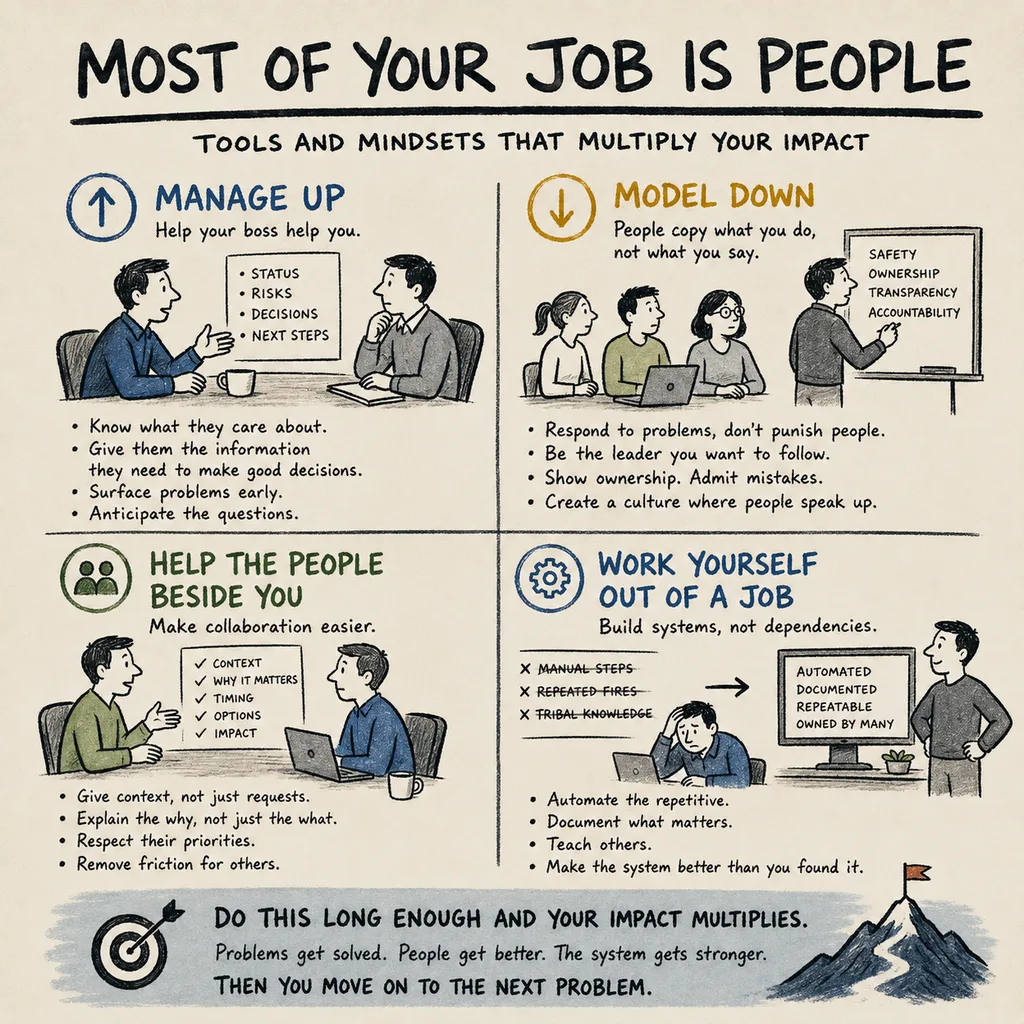
I am the only one who knows how to do this. It is not the flex people think it is; most of the time it means part of the system only works because you are standing next to it. Working yourself out of a job does not mean making yourself useless. It means removing the broken, fragile, one-person-dependent parts of your work so the system no longer needs babysitting. The best engineers do not protect a little kingdom of broken things. They make the kingdom unnecessary, and earn their way into bigger problems.
The demo worked, the team hit the date, and everyone felt good for about thirty minutes. Then the support tickets started. Boring software is not dull to build, it is uneventful to operate. The thing you ship can be clever and satisfying, but running it in production should be routine: practiced rollbacks, clear ownership, and no reliance on heroics. That kind of boring is engineered, not accidental.